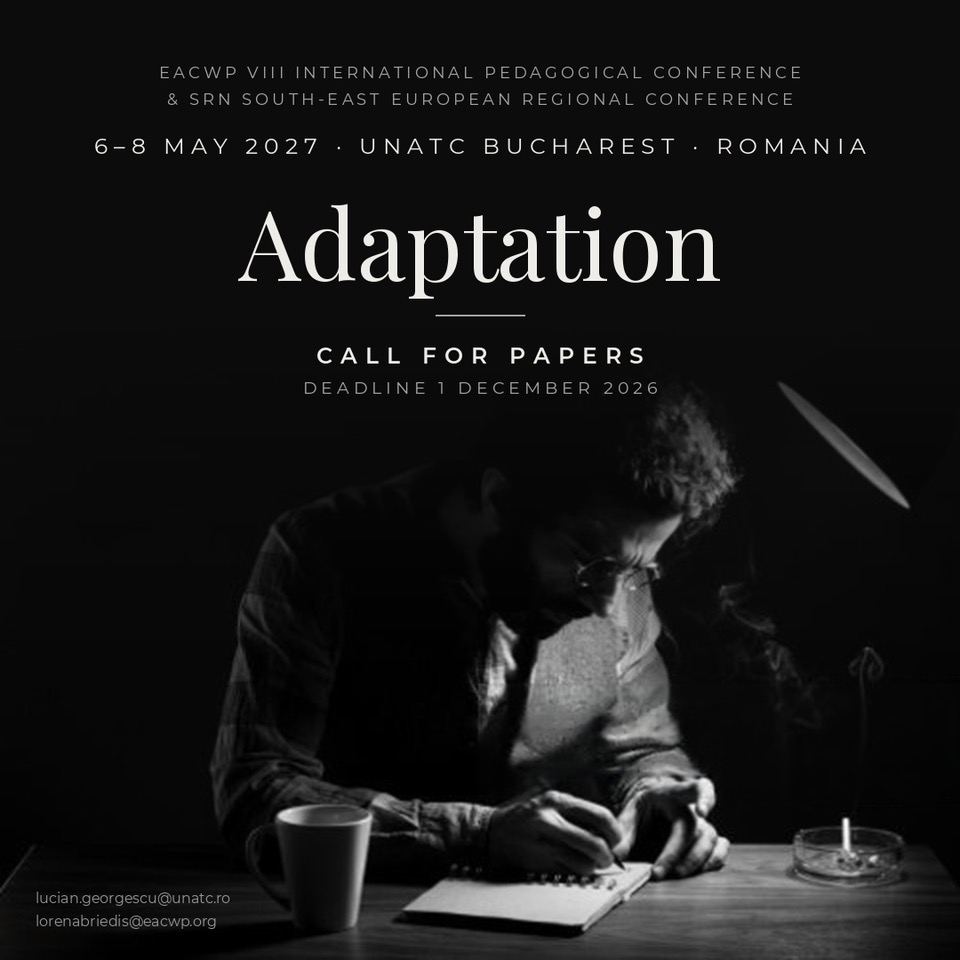
Call for Papers
EACWP VIII International Pedagogical Conference and the SRN South-East European Regional Conference
Bucharest, 6–8 May 2027
Jointly convened by the European Association of Creative Writing Programmes (EACWP) and the Screenwriting Research Network (SRN). Organised by UNATC, CARA and CINEPUB, hosted by the “I.L. Caragiale” National University of Theatre and Film, 75–77 Matei Voievod Street, Bucharest, Romania.
« Toutes choses sont dites déjà ; mais comme personne n’écoute, il faut toujours recommencer. » — André Gide, Le Traité du Narcisse, 1891
The theme
Every story we write, film or tell has origins: translated, transposed, remembered or unconsciously revived. A century of screenwriting has been, basically, a century of adaptation — of novels, plays, news, legends, rumours, other films, or the writer’s own unfinished drafts. And now the newest “writer” in the room has read everything and adapts everything — more precisely, adopts it, without permission, at industrial scale.
Adapting means to convert: life to fiction, page to screen, screen to stage; but it also means to survive: species adapt, industries adapt, we all, teachers included, adapt. Writers are adapting texts while adapting to a machine that adopts them. Programmes are adapting curricula while adapting to funding regimes and platform economics.
Hence the three A’s of our conference:
ADAPTATION — the craft, the theory, the pedagogy, the industry: what happens in the passage between forms, and (!) who authorises it.
AI — the most consequential adaptation machine ever built, and the most literal test of what we meant by fidelity, authorship, originality and voice. Humans adapt; the machine adopts. What is next?
APOCALYPSE — the ending our stories cannot stop rehearsing, repeating or predicting: climate, war, platform collapse, the end of the author. But also, in its Greek sense, apokalypsis: an uncovering. A miracle. Is writing still capable of one?
Possible topics
- Adaptation as craft and theory — page to screen and back; fidelity and its afterlife; adaptation as translation, appropriation, critique; adapting the unadaptable (interiority, voice, poetry, silence); adapting testimony, archive and the real story.
- Screenwriting as an adaptive medium — the screenplay as provisional, endlessly rewritten object; development, notes culture, adaptation by committee(s); feature to series, film to games, podcast to screen; writers’ rooms as “adaptation machines”. Sequels, prequels and reboots as the prehistory of AI adaptation: the business model of an industry in which, as William Goldman put it, “nobody knows anything” — which is precisely why it prefers to adapt what has already worked.
- Pedagogies of adaptation — teaching adaptation as a creative writing method; exercises that work; assessing a transposition; screenwriting inside creative writing programmes and vice versa; practice-as-research; teaching across languages.
- Adaptation vs. adoption (AI) — generative systems as adaptation engines; whose corpus, whose voice; the elephant in the classroom: the infinitely patient collaborator; assessment integrity and the honesty of our own policies; labour, consent and training data; AI refusal as a creative position.
- Apocalypse and the sense of an ending — climate, war and displacement in European writing; post- and pre-apocalyptic form; the periphery, the ruin of the Empire, the border; the collapse of attention, of the low/mid-budget film, of the reading public — and what role writing can still play here.
- Institutions, industries, regions — small languages and large platforms; streaming and the commissioning of adaptation; building creative writing where it barely exists; heritage cinema and the recirculation of a national canon.
How to submit
We welcome proposals from academics, teachers, writers, practitioners and doctoral researchers, members of EACWP or SRN or not, in English, French, Spanish, German or Romanian.
Send a single Word or PDF file with: title; abstract of 250–300 words; three to five keywords; author bio of up to 100 words; and the format you propose — individual paper (20 minutes plus discussion), panel (three participants on a common theme, 60 minutes; one abstract plus a bio per participant) or workshop (90 minutes). Creative writing or reading workshops with creative approaches to adaptation are particularly welcome.
Proposals should be emailed to lucian.georgescu@unatc.ro by 1 December 2026, subject line “Adaptation Bucharest 2027 – Surname”. One individual proposal and/or one panel or workshop per participant.
Key dates
| Deadline for proposals | 1 December 2026 |
| Notification of acceptance | January 2027 |
| Programme published | April 2027 |
| Conference | 6–8 May 2027 |
The conveners
EACWP, the European Association of Creative Writing Programmes, brings together more than thirty of Europe’s leading schools and courses in the art of writing, united by the conviction that imagination can be taught, and taught best across borders and languages.
SRN, the Screenwriting Research Network, is the world’s leading international community of screenwriting scholars and practice-based researchers, meeting every year on four continents. Bucharest will host the first Balkan / South-East European conference in the network’s history.
The hosts
UNATC, the “I.L. Caragiale” National University of Theatre and Film, is Romania’s leading school of theatre and cinema, founded in 1950 and the alma mater of many of the directors, writers and actors who built the New Romanian Cinema.
CARA, the Carabăț Academic Research Centre, is UNATC’s centre for research in screenwriting, named after the screenwriter and professor Dumitru Carabăț, author of one of the hidden gems of Eastern European screenwriting wisdom, Towards a Poetics of the Screenplay. The Centre brings together doctoral and practice-based research on the screenplay, the screen idea and the teaching of writing for the screen.
CINEPUB, the Cinepub Cultural Association, runs Romania’s free-access streaming platform for heritage and independent film, making the national canon available to the public and to researchers. It is also a hub of creative practice for writers and filmmakers alike.
More info: lucian.georgescu@unatc.ro lorenabriedis@eacwp.org